Showing posts with label Math. Show all posts

Thursday, May 24, 2012

Busy, busy, busy!

The last six weeks of school always seem to be the busiest - and this year is no different.

An empty office at the Department of Parks and Recreation.
- We have been role-playing with Kelli as city department workers - and going out into our own communities to find evidence of city departments at work.  We will even have some government workers come in to talk to us and answer our questions.
- We have been growing lots of new plants!  We now have cuttings from ivy plants growing on our windowsill as well as wheat growing inside of straws!
- We visited the Brooklyn Botanical Gardens on Tuesday and explored some of the thousands of plants in the gardens - we smelled them, touched them, looked at them - it was a great experience.
Swimmy [Book]

- We have been using clocks to explore elapsed time and creating timelines of events.
- We are currently writing play scripts based on Leo Leonni books we read independently.  We wrote a class play script about Leo Leonni's book Swimmy and acted it out too!
- We are reading more and more challenging chapter books and really growing as readers as we notice lots of new things as we read.
- Today we are having a visitor come to speak to us about Kenya - the country where our pen pals live.

...Whew!  And that's only some of the great things we're doing in second grade!  As the year winds down, though, we will need some time to reflect back on our year.  I'll be posting the students' reflections here as we work on them.

Thursday, May 10, 2012

A hodgepodge

I feel like there is so much going on that I can't choose just one topic to focus on!

Firstly, we are really immersing ourselves in plants!  We now have a whole collection of carnivorous plants (thanks to a great parent!) and we are exploring them first-hand now that we've done so much research on them.

We also have grass growing on the window ledge.  We will be "mowing" it next week to see how plants grow.

Our brassica plants may be wilting and dying - but the seed pods are now forming!  Next week we can plant our new seeds to start new plants!


In non-plant related news, yesterday was our last Cook Shop lesson.  We celebrated the end of this excellent program by making a recipe that used all 5 food groups.  Can you spot them all on our ingredients table?


A few kids asked for the recipe so here it is:

- 2 cans black beans, drained
- 1 head lettuce, washed and cut into strips
- 2 apples, diced into small pieces
- 1 red pepper, diced into small pieces
- 1 bag of low-fat shredded mozzarella cheese
- 8 whole wheat tortillas
- 1 tsp. chili powder
- 1 tsp. cumin seeds


Mash the beans and mix in the chili powder and cumin seeds.  Then spread it on the tortilla.  Sprinkle on the cheese.  Then add the apples and peppers.  Next top it with lettuce.  Roll up the tortilla and eat.  Can be served with salsa or low-fat Greek yogurt.


We also began our drama residency with Kelli yesterday.  We have immersed ourselves into the world of TV journalism to find out about how New York City runs.  Tomorrow we will be going on a community walk to search for evidence of City Government Agencies.  Stay tuned for lots more from this amazing project!

And finally...in math we left the Land of Inch and met a new king in an unnamed kingdom.  This ruler of the land measured everything with his foot.  But when he gave measurements to his carpenter for a new stall for his daughter's horse, it could only fit a pony!  We figured out it was because the carpenter's foot was much smaller than the king's foot!  We wrote letters to the king explaining that because the measurement tool wasn't standard in size, none of his buildings would be either.  The carpenter cut a piece of wood that was the same size as the king's foot to use to measure with before she cut or built anything.  She called  this standard-sized measuring tool a "Ruler" in honor of the king.  We are now using rulers to measure in class.  ....They sure are similar to our 12-inch-brick measuring tool, though!


Wednesday, May 2, 2012

The Land of Inch

The Land of Inch can only be visited very late at night by pressing on the castle's door.
Our teacher, Liz, has visited once to get our new measuring tools from Princess Funer.
The Land of Inch is far, far away.  In this miniature land, there is a beautiful (and brilliant) princess who lives in a castle with her father, the king.  One day, the king asked that all of the athletes in the land see who could jump the farthest.  Unfortunately, all of the athletes measured their jumps with different units.  Some measured using blocks, others with sticks, some with their feet, and others with pieces of paper.  No one knew who won because they couldn't compare the distances!

Then Princess Funer noticed a pile of bricks by the castle door.  She had all of the athletes jump again and they all measured their jumps with bricks.  They could now see who the winner was because they were using a standard measuring tool.

The people of the Land of Inch loved this and started carrying bricks with them all of the time to help them measure things.  Soon, though, they realized that bricks are heavy and lots of people were complaining of aching backs.  So, Princess Funer decided to trace the bricks on paper and give out pieces of paper that were the same size as bricks - but were a lot lighter to carry.  She called these papers "Inch Bricks" because they lived in the Land of Inch.

We used Inch Bricks yesterday to measure the long jumps.  One miniature jumper had a jump as long as a pencil.  Another had a jump as long as a sheet of paper.  Yet another jumper had a jump as long as our pencil bins.  The fourth jumper had a jump as long as the width of a sheet of paper.  We used Inch Bricks to see who won.


One student, though, voiced a complaint.  He said using Inch Bricks was difficult because you had to be careful not to overlap bricks or leave spaces between bricks and you had to be sure they were exactly straight to get the right measurement.  We brought this complaint to Princess Funer and she used magical glue to create Inch Brick Measuring Tools.  She glued 12 of the Inch Bricks together in a straight row so that it was easier to measure.


Today we used that Inch Brick Measuring Tool to measure the sizes of clothing the king and his subjects wear.  We also compared them - how much shorter is Kip's jacket compared to the king's robe?  What about Nap's sweater compared to Kag's knee socks?


Tomorrow we will help the king measure his gardens.  They're quite big -- bigger than our Inch Brick Measuring Tools.  We'll have to come up with a solution for that problem.

On Friday we will be using our Inch Brick Measuring Tools to create accurate maps of the Land of Inch.  Stop by the hallway outside of room 205 to see what we're doing to help the Land of Inch!

Thursday, March 29, 2012

Yektti Aliens

Yekttis are aliens that were that live in abandoned prairie dog, gopher, or groundhog holes.  These aliens seem friendly enough, but they never come fully out of their holes.  We can only ever see their heads.

Over the summer, two second-grade students found a large group of Yekttis living near one another.  In observing these Yekttis, one of the students made sketches of all of the ones she saw.  She noticed that while they were all similar, no two were exactly alike.

Using her sketches, we can play "Guess My Rule" - a game of sorting.

The first day we observed her sketches, we noticed that some attributes of the Yekttis changed.  Some had ringed eyes and other had plain eyes.  Some had one antennae, two antennae, three antennae, or even four antennae.  Some had square-shaped heads, rhombus-shaped heads, hexagon-shaped heads, or triangle-shaped heads.  We sorts piles and piles of these cards as a group first to get used to the process.


We then began our "Guess My Rule" game.

One student takes a rule card.  It names one attribute of a Yektti.  That student draws four Yektti cards and sorts them -- putting them inside a loop of yarn means they meet the rule.  Putting them outside of loop of yarn means they do not meet the rule.  In turn, students at the table draw another Yektti card and try to sort it correctly - even though they don't know the rule.  After a few rounds, students can try to guess the rule.  If you guess correctly, the game begins again with a new rule.  If you guess incorrectly, you sit out that round and just observe.  We shouldn't make hasty guesses we aren't positive of!


If you click HERE you can download all of the rule cards and Yektti cards for yourself.  Have your child play at home - take turns being the person who knows the rule and the person who does not.  It's a fun game that helps us sort information - a great skill as we move further into our data-collection unit.

Thursday, March 22, 2012

Even or Odd?

In math we have been exploring the differences between even and odd numbers.  We used cubes, number sentences, and our prior knowledge to list a whole lot of fun facts about even and odd numbers!


We know that even numbers can be put into pairs (partners of two) without any left over.  We practice this every day when picking line partners!

We know that even numbers can be put into two equal sized groups.

We know that even and odd numbers alternate when counting.  even, odd, even, odd, even, odd...

We know that an even number + an even number = an even number.

We know that an odd number + an odd number = an even number.

We know that an even number + an odd number = an odd number

We know that an odd number + an even number = an odd number

We know that even numbers end with 0, 2, 4, 6, or 8

We know that odd numbers end with 1, 3, 5, 7, or 9

Wow!  We know a lot!

Wednesday, January 25, 2012

T-Shirts! Get your T-Shirts!

Today is our T-Shirt sale after school!  We will be selling the remaining tie-dyed shirts we have for $5.00 in the school yard.  We've sold half of them already to staff, students, and parents who have come in to inquire about our factories.

In our Math T-Shirt factory, we have made a divide.  We've decided that having one big factory was just too much - so we split into 5 smaller factories.  We are now...

The Lightning Bolt Factory
Rock and Roll Factory
Planet Shirt Factory
The Awesome T-Shirt Factory
Exterminator Factory

Our five factories got all of our inventory in the 4 sizes we carry, Small, Medium, Large, and X-Large.  The problem was, I got sloppy when giving out the shirts and just piled shirts as I pulled them off of the shelves.  I was not organized!

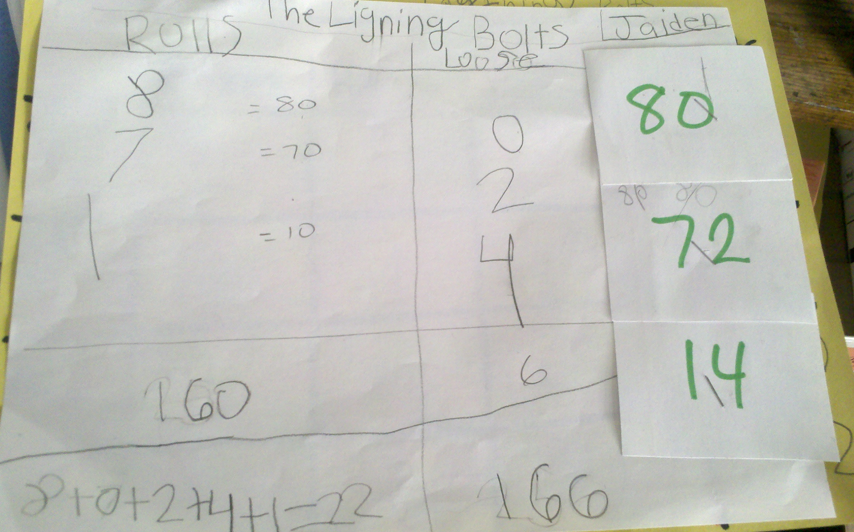
Before each factory could start advertising and selling their shirts, they had to figure out how many shirts of each size they now have!  So, each factory worker had to add up the piles I made to figure out how many shirts they had in all.  Here is the work the four factory workers from The Lightning Bolt Factory:


They determined that they have 189 Smalls, 90 Mediums, 166 Larges, and 162 X-Larges.
Next they had to figure out, as a group, how to store their shirts in their own warehouse.  They saw how confusing it was when the shirts weren't organized, so they put shirts into boxes and rolls when they could.

A box holds 100 shirts - or 10 rolls.  A roll holds 10 shirts.  And of course, sometimes there are just loose shirts that can't be put into a full roll or box.

Here is the inventory for The Lightning Bolt Factory:


Today they will figure out what their ledger will be before they start selling.  Each factory will be selling their shirts for $10 each.  So how many shirts are there all together?  How much are all of their shirts worth?  Today we will answer these questions so that we're ready for the orders to start coming in!

Wednesday, January 18, 2012

T-Shirt Factory!


Our T-Shirt Factory is open!

In math, we are studying place value, addition, and subtraction.  To make it come alive, we've opened a T-shirt Factory!  In our factory, shirts can either be stored as loose shirts, in rolls of 10, or in boxes of 10 rolls (100 shirts).  Using these amounts, we can find equivalent numbers, add and subtract shirts, and break apart numbers.

First, orders started rolling in.  If an order for 78 shirts came in, we had to ask ourselves, "How many rolls of shirts is this?  How many loose shirts?"  At first, we only looked for the most efficient way - 7 rolls and 8 loose shirts.  Now are looking for all the possible ways to make this order:

Order for :: 78 shirts

ROLLS     |     LOOSE SHIRTS
0                |     78
1                |     68
2                |     58
3                |     48
4                |     38
5                |     28
6                |     18
7                |       8


Using this strategy, we see that 6 tens and 18 ones is equal to 2 tens and 58 ones or to 7 tens and 8 ones.

Today we will begin combining orders.  How can we use this strategy of breaking apart numbers to easily add larger amounts?  Today we will explore just that.

Of course, at EVCS we don't keep math just inside of the math workshop!  We tie-dyed shirts last week during our Family Friday!  We learned new art techniques and had a great time.  On Wednesday, 1/25/12, we will be selling our remaining shirts in the yard after school.  Now our factory feels quite real!

Saturday, December 31, 2011

T-shirt Factory

In January, the second graders will be opening a T-shirt factory during our math workshops. We will be studying place value by using T-shirts as our real-world models. As an extension of this unit, we will be tie-dying shirts like the shirts in our math story book.

Please email me your child's shirt size as soon as possible!

Choices:
Youth small
Youth medium
Youth large
Adult small
Adult medium
Adult large

The shirts are 100% cotton and therefore may shrink a bit.
Thanks!

Tuesday, December 20, 2011

Rectangles

We have been focused on geometry in math this month!  We've done so much with shapes!

We've explored both 2D and 3D shapes.  We learned a lot of new information and vocabulary about 3D shapes.  Ask your child about the faces and angles of shapes like cubes or rectangular prisms.  We have a lot to say!

Currently, we are exploring rectangles.  What, exactly, makes a rectangle a rectangle?  We already knew it was a polygon, but why are some polygons called rectangles and other polygons not?

In our studies, we've learned that a rectangle is a shape that has 4 sides (which we now call a quadrilateral!) and has 4 right angles.  We searched for quadrilaterals in our homes and found that most have right angles.

In our rectangle study we are also discovering how to figure out their size.  What does it mean to say that rectangles are bigger or smaller than other rectangles?  Is it how tall they are?  How wide they are?

We mathematicians sure ask a lot of questions!

Yesterday we made different rectangles and recorded them on graph paper.  We discovered that whether it was tall and skinny, short and fat, or somewhere in between, it always held the same number of tiles!

We now know that finding the space inside of the rectangle -- called the area -- is how we determine which rectangle is the biggest or smallest!